| |
Clinical Benefits of Oscilllometry
in Respiratory Assessment
|
 |
| Oscillometry is a non-invasive lung function test that evaluates respiratory mechanics during normal tidal breathing. By measuring how the respiratory system responds to small pressure oscillations, it provides information that complements conventional spirometry. Its low requirement for active effort makes it particularly useful when patients have difficulty performing reproducible forced breathing manoeuvres. However, oscillometry still requires appropriate technique, patient cooperation and quality control. |
| |
 |
| |
| Principles of Respiratory Oscillometry |
|
Oscillometry, also known as the forced oscillation technique, applies small pressure oscillations at the mouth while the patient breathes quietly. The relationship between pressure and flow is used to calculate respiratory impedance.
Impedance comprises two principal components: |
|
 |
| Resistance (Rrs) |
|
| reflects opposition to airflow within the respiratory system. |
|
|
|
 |
| Reactance (Xrs) |
|
| reflects the combined effects of elastic and inertial properties. |
|
|
|
|
| These measurements describe the behaviour of the respiratory system as a whole, including the airways, lung tissue and chest wall. They should not be interpreted as direct measurements of an individual airway compartment. |
| |
| How Oscillometry Complements Spirometry |
|
| Spirometry measures the volume and flow of air during breathing manoeuvres, including forced expiration. Common parameters include forced expiratory volume in one second (FEV₁), forced vital capacity (FVC) and the FEV₁/FVC ratio. Oscillometry assesses respiratory mechanics during tidal breathing, offering a different perspective on functional impairment. |
|
|
|
|
| Spirometry alone does not measure residual volume, total lung capacity or gas transfer; these require separate pulmonary function tests. |
| |
 |
|
Applications in Asthma and COPD
In asthma, oscillometry may identify abnormalities in respiratory mechanics when spirometry is preserved. It can also provide additional information about physiological changes following treatment. An abnormal oscillometry result alone does not establish an asthma diagnosis.
In COPD, resistance and reactance measurements can help characterise mechanical impairment. Within-breath measurements may provide information about expiratory flow limitation during tidal breathing. Oscillometry complements the clinical assessment and does not replace spirometry for confirming persistent airflow obstruction. |
|
| |
| Assessing Responses to Bronchodilation & Bronchial Challenge |
|
Oscillometry can assess changes after bronchodilator administration and responses during bronchial challenge testing.
These are distinct applications: |
|
 |
| Bronchodilator Responsiveness |
|
| evaluates change after a bronchodilator. |
|
|
|
 |
| Bronchoprovocation |
|
| evaluates airway responsiveness to a challenge. |
|
|
|
|
| Interpretation requires appropriate protocols and validated thresholds. Greater sensitivity to physiological change does not automatically mean greater diagnostic specificity. |
| |
 |
|
Supporting Patients Who Find
Forced Manoeuvres Difficult
Oscillometry may be useful in young children, older adults and selected patients with physical or neuromuscular limitations. Suitability depends on whether the patient can maintain an adequate mouthpiece seal and sufficiently stable breathing.
Applications in occupational exposure, restrictive disease and sleep-related breathing disorders continue to be investigated. Oscillometry does not replace dedicated assessments such as respiratory muscle testing or diagnostic sleep studies. |
|
| |
Measurement Quality Remains Essential
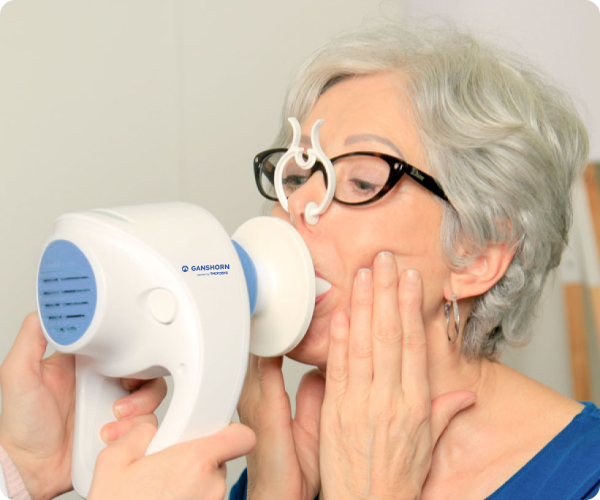
Reliable testing requires correct posture, cheek support, a nose clip and an effective mouthpiece seal. Coughing, swallowing, leaks and irregular breathing can affect results.
ERS technical standards recommend performing oscillometry before tests involving deep inspirations, such as spirometry, because these manoeuvres can alter respiratory mechanics. Results should be assessed using appropriate reference values and consistent measurement procedures.
Integrated with symptoms, clinical history and other lung function measurements, oscillometry can broaden respiratory assessment while reducing the need for demanding breathing manoeuvres. |
|
 |
|