| |
Spirometry in Clinical Practice:
|
| Assessing Airflow and Supporting Respiratory Care |
 |
| Spirometry is a fundamental pulmonary function test used to assess airflow and exhaled volumes. It supports the investigation of respiratory symptoms, evaluation of treatment response and monitoring of lung function over time. When interpreted alongside clinical history, examination and other investigations, spirometry provides objective information that helps clinicians assess respiratory impairment and guide further care. |
| |
 |
| |
| What Does Spirometry Measure? |
|
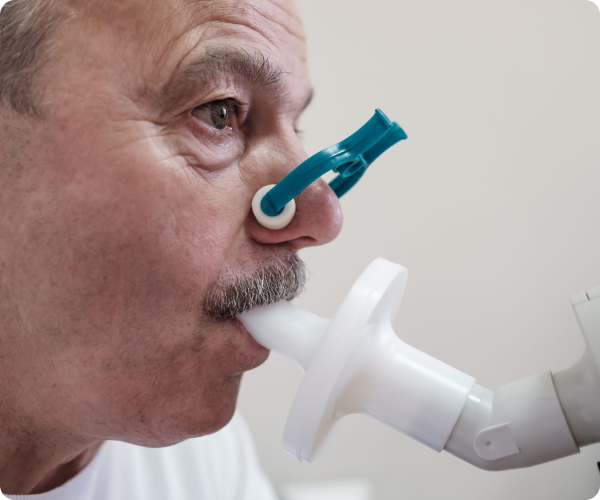
During a forced spirometry manoeuvre, the patient inhales fully and then exhales as forcefully and completely as possible through a mouthpiece.
The principal measurements include: |
|
| Forced vital capacity (FVC) |
Total volume exhaled during a compplete forced expiration following maximal inspiration |
|
Forced expiratory volume
in one second (FEV₁) |
Volume exhaled during the first second of the manoeuvre |
|
| FEV₁/FVC ratio |
Proportion of the forced vital capacity exhaled in the first second |
|
|
|
| These measurements are obtained from the same manoeuvre. Flow–volume and volume–time curves help assess the breathing pattern and technical quality of the recording. |
| |
 |
|
When Is Spirometry Appropriate?
Common indications include investigating persistent cough, wheeze or breathlessness; assessing suspected obstructive airway disease; monitoring established respiratory conditions; and evaluating changes following treatment.
Testing may also form part of occupational respiratory surveillance or selected preoperative assessments. The decision should reflect the clinical question, the patient’s ability to perform the manoeuvre and any relevant precautions.
Spirometry is generally well tolerated, but forced expiration requires effort. Testing should be stopped if the patient develops pain, and the operator should assess any significant distress. |
|
| |
Understanding the Results
A reduced FEV₁/FVC ratio can indicate airflow obstruction. Interpretation should use appropriate reference values and the diagnostic criteria relevant to the suspected condition.
A low FVC does not, by itself, confirm restriction. Reduced values can also arise from air trapping, incomplete inhalation or premature termination of expiration. Measurement of total lung capacity may be needed to establish a restrictive ventilatory impairment.
Normal spirometry does not exclude every respiratory disorder. Depending on the presentation, further assessment may include bronchodilator testing, bronchial challenge, oscillometry, lung volumes or gas-transfer measurement. |
|
 |
|
| |
 |
|
Spirometry in Occupational Health
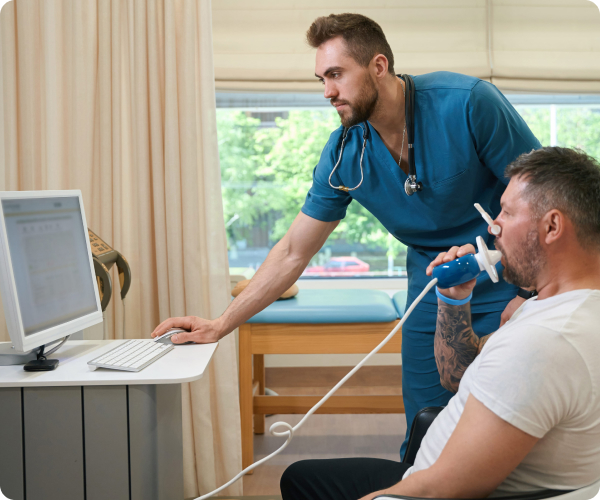
For workers exposed to respiratory hazards, spirometry can contribute to a structured surveillance programme. Baseline and follow-up measurements may help identify changes that warrant further investigation.
Results should be considered alongside exposure history, symptoms and workplace risk assessment. An abnormal tracing does not independently establish that a disease is occupational, while normal spirometry does not exclude all exposure-related lung injury. Consistent testing methods & review of serial results are important. |
|
| |
Quality Depends on Technique & Equipment
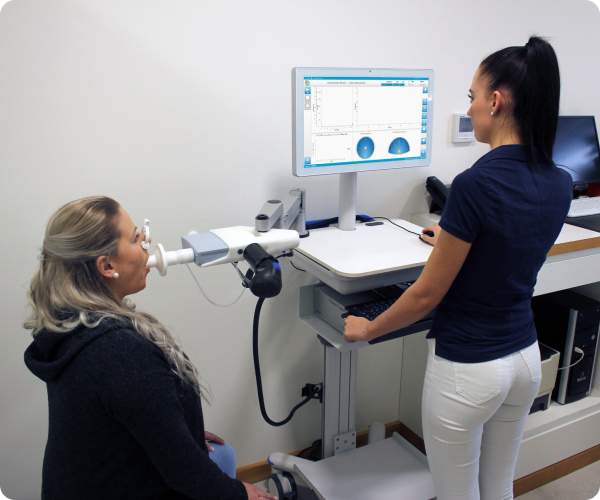
Reliable spirometry requires trained operators, clear coaching and assessment of manoeuvre acceptability and repeatability. Software prompts and visual feedback can assist testing, but the operator must still review the curves and recognise technical problems.
Equipment verification is also essential. A sensor described as calibration-free does not remove the requirement for calibration verification under ATS/ERS standards. Cleaning, infection prevention and maintenance should follow the current manufacturer’s instructions. |
|
 |
|
| |
 |
|
SpiroScout:
Ultrasonic spirometry for Clinical Workflows
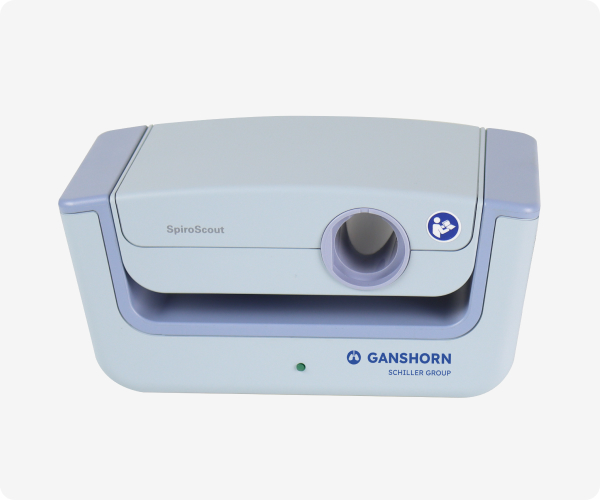
The GANSHORN SpiroScout uses ultrasonic technology to measure respiratory flow. Its LFX software provides graphical displays, manoeuvre animations, quality-control tools and configurable reports to support testing and interpretation.
These features can support the delivery of spirometry in an appropriately staffed clinical service. Effective implementation also requires operator training, quality assurance and a pathway for clinical review and further investigation.
Spirometry provides its greatest value when performed for a clear clinical indication and interpreted in context. High-quality measurements help clinicians assess airflow limitation, follow changes over time and determine when a more comprehensive respiratory evaluation is needed. |
|